The Data Initiative: a Detailed Summary

On Tuesday, February 18, 2020 at the Nashville Technology Council’s Tech Hill Commons facility, MTSU announced the Data Initiative.  In attendance were over 25 representatives from companies, the Presidents and staff from the three local chambers, government officials, including THEC Executive Director Mike Krause, K-12 administrators, and several faculty and administrators from MTSU to hear about what MTSU is doing in Data Science.  To see a highlight of the day, please watch the video below or click here for the press release.

What is the Data Initiative?


This blog is intended to give specific information on exactly what is the Data Initiative and how it will look to propel MTSU as a leader in data science education.  This initiative brings together all things data related at MTSU in education, research and projects, and student experiences.  By bringing “all things data” together it allows MTSU to offer the experiences needed to be successful in data science. The Initiative includes:

  • Data Science Bachelor of Science Degree (Starting in the Fall 2020)
  • Data Science Graduate Certificate (Starting in the Fall 2020)
  • PhD. in Computational Science (Started in 2011 and currently has 44 students and has graduated 24 PhD.’s.  A new Data Science concentration will be available in the Fall 2021.)
  • Data Science Institute (Started in 2018)
  • Innovative Programs (Starting this Spring 2020 and is creating programs from K-12 to career ready)

The Data Science Bachelor of Science is the first public data science undergraduate degree in the state of Tennessee and it provides a unique interdisciplinary approach to education that includes courses and faculty from several departments, including Computer Science, Mathematics, Information Systems & Analytics, and Economics and Finance. This degree leverages the strengths of MTSU by bringing the best of all of these areas together to create future career ready professionals.

Students will take courses in programming, statistics, analytics, database, and machine learning as well as selecting a concentration in either Inferential Thinking, Business Intelligence, or Advanced Machine Learning.  Not only will students be taking innovative and interdisciplinary courses, but they will also be able to put those skills to good use through ‘real-world’ projects through the Data Science Institute and events such as Data Dives and Hackathons.  A degree that truly makes you career ready through courses and experiences to create data driven problem solvers. For more information, please visit https://mtsu.edu/programs/data-science/.

The Graduate Certificate in Data Science is for anyone that already completed a bachelor’s degree and believes that adding the necessary data skills will enhance their current situation.  Data Science is for everyone and this Graduate Certificate allows any working or aspiring professional the opportunity to get started.  The only prerequisite is a bachelor’s degree.  We encourage individuals from every industry and skill levels to be a part of this program.  To read more about the program, including courses and schedules, please visit https://www.mtsu.edu/dsi/gradcert.php.

The PhD. in Computational Science prepares students for research careers in academia, government, industrial laboratories, and data science preofessions by emphasizing the key role of computation in the physical, biological, and mathematical sciences. Research-intensive studies in computing, mathematics, and science provide the foundation needed to solve real-world problems across the disciplines. MTSU’s program emphasizes both simulation and data-intensive science, giving students the skills they need to model complex systems and handle the huge volumes of data generated in modern scientific experiments. A partnership among faculty from eight different departments results in a unique interdisciplinary education that prepares graduates to adapt and grow as computing systems and scientific research evolves. Most students in the doctoral program can also complete a master’s degree in either Mathematics or Computer Science. A Data Science concentration will be available in the Fall 2021.  For more information, please visit https://www.mtsu.edu/programs/computational-science-phd/.

The Data Science Institute bridges the gap between academics, research, and industry by providing real world experiences and research opportunities to students and faculty to make an impact with our community.  The Data Science Institute has worked with several private and non-profit orgainzations to analyze data to make more impactful decisions.  Some of the more recent projects includes non-profits such as Second Harvest Food Bank, Special Kids Therapy and Nursing, Murfreesboro Police and Rutherford County Schools.  The Data Science Institute conducts research in the environmental and sustainability space to gain insights on water pollution.  

Another aspects of the Data Science Institute that provides opportunities to our students are events, such as Data Dives.  A Data Dive is a data hackathon that allows students to work with a non-profit or private company and their data to provide insights.  Data Dives range from 16 hours to 36 hours.  these events allow everyone interested in data science to come together (regardless of expertise) and work on learning and experiencing the process of data science and how to solve a problem.

Finally, the Tennessee Data Initiative includes Innovative Programs, which is an opportunity for MTSU to provide educational opportunites from K-12 to career ready.  This includes curriculum and programs for high school courses, so that teacher are provided the right resources to teach data science.  It includes opportuntites for executive education, workshops, online education, and the creation of a data playground which will include datasets and educational resources to learn data science and give you an experience to reinforce what you learn.  Stay tuned, we expect to continue to post with our new programs and we fully expect to provide some content for FREE.  

These five programs together will help MTSU lead the charge in Tennessee for data science.  We fully understand that to create career ready data driven problem solvers, we not only need good educational content, but also experiences for our students that allow them to play and enhance their data skills.  Becoming a data scientist includes skills in programming, statistics, business, and most importantly the ability to think through and solve a problem.  The Tennessee Data Initiative is intended to allow students to learn and experience data science to be come more career ready.

Click the following for more information about the Data Science Programs  and the Data Science Institute.


MTSU announcement of the Tennessee Data Initiative
Instrumental Individuals for the Tennessee Data Initiative
(from left: Mike Krause (THEC Exec, Director), Charles Baum (TN State Rep.), Mary Martin (MTSU Board of Trustee), Ryan Otter (Director of the Data Science Institute), Charlie Apigian (Director of the Data Science Institute), Sidney A. McPhee (MTSU President), Lisa Green (Director of Data Science B.S.), Mark Byrnes (MTSU Provost), David Butler (Dean of Graduate Studies), Cayson Seipel (Student at MTSU), and Tom Boyd (MTSU Board of Trustee).
Data Science Institute 2019 – A Year in Review and a Look Forward to 2020

Now that 2019 is in the past and we are getting ready to roar into the ‘20s, it is a good time to look back at what was accomplished and what we have to look forward to this year. The Data Science Institute was started in May 2018 and throughout 2018 planning was in place to identify the strategic objectives of the institute and what it can do to promote student development, support for faculty and research, and make an impact within our community. With the help of a MTSU advisory board, several key objectives were identified to accomplish in 2019, which revolve around projects and research, events, and education. Below selected list of projects, research, events, and educational initiatives that occurred in 2019 that will help MTSU continue to lead in the area of data science.

  • The addition of Dr. Ryan Otter as a Director for the Data Science Institute
  • Hack MT and the creation of Data Dives
  • Kirk Borne on campus and in Nashville hosted by the Data Science Institute
  • Approval of the Bachelor of Science in Data Science – to start in the Fall 2020
  • Creation of the Data Science Graduate Certificate
  • Murfreesboro Predictive Policing Project
  • Research and external projects are going strong with over $800,000 in grant funding

The Data Science Institute adds Dr. Ryan Otter as a Director

ryan-otter-1170x878.jpgOne of the key additions in the Spring 2019 that helped propel the Data Science Institute into several research and external projects was the addition of Dr. Ryan Otter. Dr. Otter is a Professor of Environmental Toxicology in the Department of Biology. He has been involved in several big data initiatives and externally funded research projects, including the most comprehensive toxicology database in the world. Since joining the Data Science Institute, Dr. Otter has been instrumental in bringing in funding for several projects and also has a deep passion for helping to get students career ready in data science.


Hack MT starts the year off right with Using Data for Good with Second Harvest

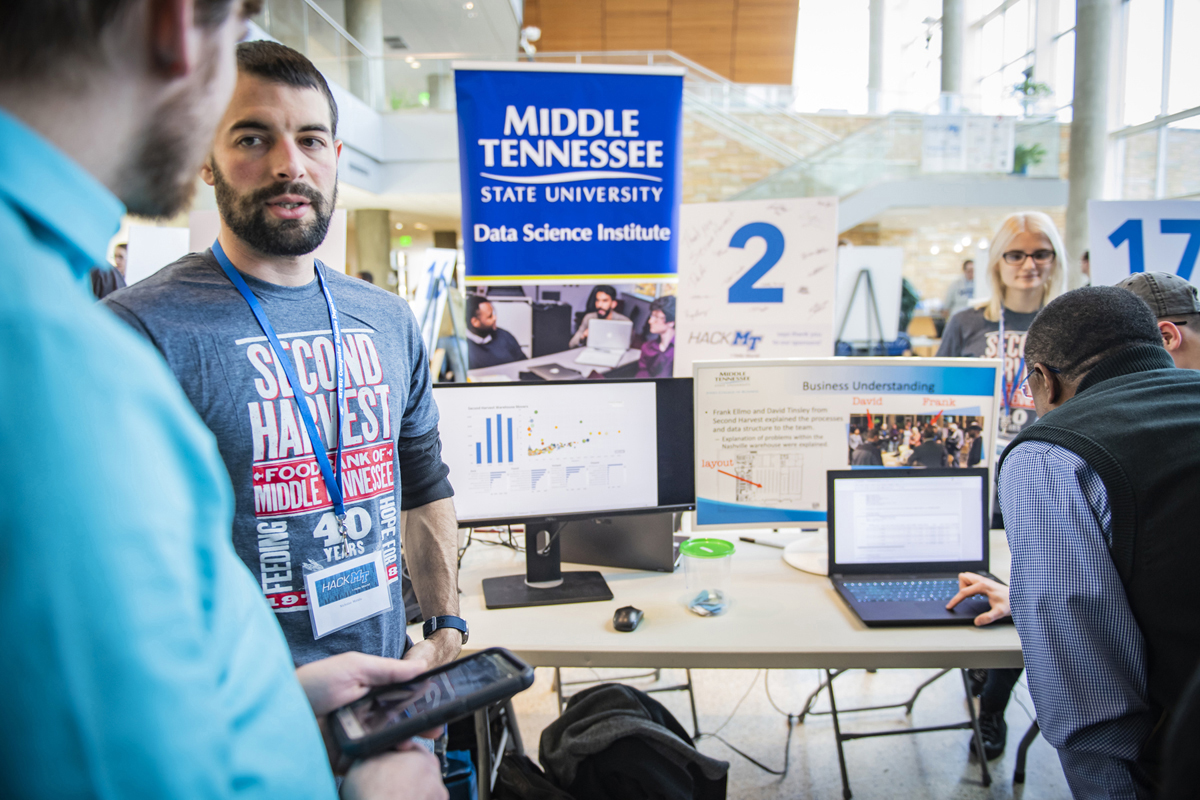
Part of the objective for 2019 was to get individuals involved and interested in data science. To start this off the right way, the Data Science Institute connected with Second Harvest to attend Hack MT in January, to analyze their warehouse data to become more efficient within in storage and shipment of food to those in need. With the help of Frank Elmo, Director of Operations, and David Tinsley, Director of IT, data was aggregated and pitched as an idea at the 36 hour hackathon. A team of 25 students from 5 different universities tackled the data and in the end presented their findings to Second Harvest and MTSU. The results was second place overall and winning the Hacker’s Choice Award. To read more about the event, please click here.

Data Dives – Using Data for Good

After the success at Hack MT, the idea for a data hackathon specific for the Data Science Institute was proposed by the MTSU Data Science Institute advisory board by Dr. John Wallin. At one point, he termed it as a data dive, and concept and name was born.


A Data Dive is a data specific hackathon where one dataset is used by all groups to dive deep into data to answer specific objectives. This could include any application and result in visualization, story telling, predictive models, or anything else that helps the dataset owners to use their data to make better decisions.


The first Data Dive was on March 29th and 30th using the same data from Hack MT from Second Harvest. Over 75 students, 10 faculty, and 5 IT professionals attended to two-day event and analyzed the data to find trends, insight, and predictions for warehouse data at Second Harvest. This was then presented to the directors at Second Harvest at the end of the second day. This then resulted in a team that worked on Second Harvest data over the summer to provide more insight.

2019DataDiveSK.jpg

A second Data Dive was held on September 27th and 28th for Special Kids, Inc. The data that was analyzed was their donor data and teams were to look at how to create new donors, what makes up a sustainable donor, and what is the profile of a potential donor. This data dive was also held over two days with presentations at the end of the second day to the Director of Development for Special Kids, Stephanie Folkmann. This also led to a project after the event where a student and Dr. Apigian worked with Special Kids to create a dashboard that aggregated their activity data and showed donations within different time periods and categories.

The result of these Data Dives is not only analysis for the non-profits that are involved, but it is also an excellent opportunity for any student, faculty member or any external individual to dive into data with little knowledge or expertise and get started on their path to data science.


The next Data Dive will be our first 24 hour event starting on March 27th. We will also be partnering with VHT to provide expertise, data, and resources for the event. Should be an excellent opportunity for more individuals to get started with data and data science.

Kirk Borne at MTSU and Nashville

One thing for sure, the data science community is absolutely amazing and when Dr. Kirk Borne was asked to come to MTSU and Nashville to speak, he was gracious enough to accept. Dr. Kirk Borne is the Principal Data Scientist and an Executive Advisor at global technology and consulting firm Booz Allen Hamilton and is considered one of the most influential Data Scientists on Twitter, Kirk Borne (over 250K followers on Twitter).


2019_BorneFaculty.jpgDr. Borne presented along with Dr. Charlie Apigian, Shruti Sharma (Ingram Content Group), and Dr. John Liu (Intelleron) on September 25th at the Nashville Technology Council’s Tech Hill Commons for a fireside chat about AI and implications for Nashville. It was a joint meetup with Data Nerds, Data Science Nashville, and the Greater Nashville Healthcare Analytics and over 120 IT professionals were in attendance. He then presented on Thursday, 9/26 at MTSU to several student groups and presented a talk titled “You and the Environment … and Data Literacy”. Finally, Dr. Borne opened the Data Dive on September 27th with an inspirational talk about the importance of playing around with data.

The three days also included several meetings with individuals from Nashville, administration from MTSU, students and faculty. What was intriguing about the three day of events was that Dr. Borne was instrumental in creating the first data science program in the country at George Mason back in 2007 and we were in the final stages of approval for the MTSU data science program. It was a great way to put the final touches on the new program from a true leader in the field, but more importantly a wonderful and kind individual. Thank you again Dr. Borne – you were an inspiration to individuals at MTSU and the Nashville community.


Education Initiatives at MTSU – a Bachelor’s Degree and Graduate Certificate

Back in August of 2018, the idea of bachelor’s degree in data science was developed by an interdisciplinary group at MTSU comprised of Math, Computer Science, Economics and Finance, and Information Systems & Analytics. In 2019, this idea became a reality and will start in the Fall 2020. The curriculum was devised with the help of several industry experts and includes aspects from statistics, programming, business, and opportunities for students to dive into other industries, since data science needs to be infused into every discipline and industry.

Bachelor of Science in Data Science

The process for a new program at a public university is a arduous process with many steps that includes approvals at the university (April 2019), from an external review (July 2019), the MTSU Board of Trustees (October 2019), and finally from the Tennessee Higher Education Commission (November 2019). This is usually a 24 month process, but with the help from all parties involved, this proposal was submitted (January 2019) and approved within eleven months. A big thank you to everyone involved. Stay tuned for more information, as the official announcement will be in February 2020 and we will have students starting the Fall 2020.

Data Science Graduate Certificate

A second initiative at MTSU was to help individuals that are already educated but want to upskill for analytics and data science. Therefore, a team of faculty and a team from video production started working on a graduate certificate that will be different than anything that MTSU has offered in the past.

This includes four 7 week courses that can be completed in two semesters. Each course will include highly produced online content that includes business and data scenarios, the foundation of statistics, and how to program in Python. Students will learn online and then be required to attend a data dive event at the end of the 7 weeks to work through a data problem. (Yes, you heard that right! The idea of a data dive is now going to be included in curriculum.)
  The four courses are titled Data Understanding, Data Exploration, Predictive Modeling, and Model Optimization. We believe that this will be a unique opportunity for individuals that either currently work in the space and need the necessary skills to stay up to date or for individuals that are wanting to pivot into a career in data science. Are you interested? Stay tuned, more to come.

These two programs are the starting point for data science programs at MTSU. For 2020, expect a new data science track within the Computational Science PhD. Program, a new minor in data science, and a Master’s Degree will also be prosed. Also, with the help of the Data Science Institute, courses are being developed at Franklin High School and Central Magnet High School in Data Science, which gives MTSU programs at every level including high school, which allows a student in high school a path from K-12 to PhD.


Murfreesboro Predictive Policing Project

After several conversations with the Murfreesboro Police Department, a need was discovered to see if you could predict burglaries based on existing data at the precinct. With the help of their data analysts, a team consisting of one student, one faculty member from Information Systems & Analytics and the Data Science Institute team worked on aggregating data that they viewed as relevant. Through this process, 3 years of activity data was collected and demographics for each sub zone within the city limits of Murfreesboro. It was then determined that more data was needed for a reliable model and that the interval for prediction would be one week. Therefore, can last week’s call activity predict this week’s burglaries within distinct sub zones?

2019AnalyticsSummit.jpgCall activity includes any call that comes into the police department and the result of that call. For example, if someone calls up and reports trespassing, it is entered as trespassing, and then after addressing the issue, it is entered into the system with its results or disposition, such as warning or arrest. This also includes activity such as burglar alarms, intoxication, disturbance, etc. Therefore, the target variable was this week’s burglaries within a sub zone as a 0 or 1, with 1 being one or more burglaries within that sub zone. The features for the model included:

  • Call activity and dispositions from last week per sub zone
  • Call activity and dispositions from last week around each sub zone
  • Burglaries from last week per sub zone
  • Burglaries from last week around each sub zone

NOTE: We excluded demographic data to avoid any profiling issues for the police department. All predictions were based on activity only.


Throughout the year, the model was refined and with ten years of data, the model was 82.3% accurate in predicting burglaries within sub zones. The results were then implemented into a map feature for the police to view. This project was then presented at the Nashville Analytics Summit on September 10th and at the Decision Science Institute Conference in New Orleans, LA on November 24th. You can watch the presentation from the Analytics Summit at Using Data for Good: A Predictive Policing Model – Charles Apigian, Chris Germiller – NAS2019 – YouTube.

Other Projects in 2019 within the Data Science Institute

There were several other projects that were conducted with industry partners. The first project in 2018 was with Hytch Rewards LLC. We cannot thank them enough for allowing us to get started in the Data Science Institute and for being patient with us and how to develop teams for analysis. From September 2018 to April 2019, we were contracted with Hytch Rewards LLC to dive into their activity data and look for trends and analysis. This results in three reports to Hytch and offer insight into their data that was not discovered before. If you want to make a difference through carpooling by reducing congestion on our roads and being a good steward within the community, please check out Hytch Rewards and start carpooling today. https://hytch.me/

The Data Science Institute also worked on projects within MTSU that included predictive modeling, natural language processing, and visualizations. It also partnered with several companies to figure out ways to help create a better data literate workforce.

Research projects at MTSU – over $800,000 in funding

An institute at a university would not be complete without a strong research stream, both internal and external. The premise of research within the Data Science Institute is to support data driven research with faculty at MTSU. To facilitate this, Dr. Ryan Otter, who was brought in as a Co-Director, was instrumental in bringing in projects related to the environment and sustainability.


  • Awarded a USDA grant for “Advanced In-Stream Water Quality Monitoring of the Red River Watershed” at $298,475. This grant is in cooperation with Frank Bailey in Biology at MTSU and the Data Science Institute. The Data Science Institute will create the data infrastructure for this project (Awarded August 2019).

  • Awarded a USGS grant for “Remedy and Restoration Effectiveness at Great Lakes Areas of Concern” at $98,460 per year for 5 years. This will look at data that has been collected within different Great Lakes and run models to determine if specific areas or regions are at risk. The Data Science Institute will create the data infrastructure and modeling for this project. Expected total funding of up to $500,00 over 5 years. (Awarded July 2019).

What is in store for 2020?

Expect 2020 to be more of the same with a focus on career readiness for our students and the community.  With new programs, new events and projects, the Data Science Institute will be very busy making sure that they do their part to get kids ready for the world where the use of data is not just preferred, but required.  Through programs that allow students to not only learn, but also do, the Data Science Institute and programs at MTSU are ready to create the future career ready data work force.  

Kirk Borne and Data Science at MTSU

We cannot be more excited to be offering the folloiwng events for our community.  In the Data Science Institute, we have been quite active in working on opportunities for you to get involved with Data Science.  At the end of this month, (9/25 – 9/28), we have several events that we thought you would be interested in attending and getting involved with real data.

KirkBorne-2019-headshot.jpgNationally known Data Scientist, Kirk Borne (over 240K followers on Twitter), will be in Nashville (Wednesday, 9/25) and on campus on Thursday, 9/26 and Friday, 9/27.  Dr. Kirk Borne is the Principal Data Scientist and an Executive Advisor at global technology and consulting firm Booz Allen Hamilton. In these roles, he provides consulting, thought leadership, training, and mentoring in the areas of big data analytics, data science, machine learning, data management, AI, and modeling across various industries and domains. He was previously Professor of Astrophysics and Computational Science at George Mason University for 12 years where he taught data science in the graduate and undergraduate programs. Prior to that he spent nearly 20 years supporting data systems activities for NASA space astronomy missions. He has a B.S. in Physics from LSU, and a Ph.D. in Astronomy from Caltech. He is an active contributor on social media where he promotes the development and applications of digital technologies in any and all domains. Kirk has been one of the top worldwide global influencers in big data and data science on social media every year since 2013, and he was named the #1 worldwide digital influencer for 2019 in big data, data science, and AI.  Follow him on Twitter at @KirkDBorne.

Here is the schedule of the events:

The State of AI & its Impact on Nashville: A Fireside Chat with Kirk Borne (Wed. 9/25)

  • Wednesday (9/25) from 5:30PM to 8PM
  • Tech Hill Commons – 500 Interstate Blvd S Suite 210, Nashville, TN 37210
  • A night for ALL meetups to talk data and AI with Kirk Borne
    • 5:30PM to 6PM – Social Hour – enjoy food and drinks
    • 6PM to 6:30PM – A fireside chat with Kirk Borne on the state of AI
    • 6:30PM to 7:00PM – A conversation with Nashville on AI and its impact
    • 7:00PM to ?? – Questions from the audience and socializing
  • This is a joint meetup with Data Nerds, Data Science Nashville, and the Greater Nashville Healthcare Analytics 
  • We are SOLD OUT, but if we open up more spots, you will be able to register at https://aianditsimpactwithkirkborne.eventbrite.com

You and the Environment … and Data Literacy – presented by Kirk Borne (Thurs. 9/26)

  • Thursday (9/26) from 6:00PM to 8:00PM
  • MTSU – Business and Aerospace Building – State Farm Room
  • A night for ALL students at MTSU to learn more about data science and its future for you and your career.
  • This event is sponsored by the students organizations’ AIS, ACM, SME, and Economics Club and we encourage anyone interested in Data Science to join us.

Data Dive: A Data Science Institute Hackathon benefitting Special Kids (Fri. 9/27 & Sat. 9/28)

  • Friday (9/27) from 6:00PM to 8:00PM
  • Miller Education Center – 503 E. Bell Street, Murfreesboro, TN 37130
  • This event is for students, faculty, and IT professionals.
  • Click here to learn more and to register: datadive2019.eventbrite.com
  • Want to learn about Data Science and Machine Learning and make a difference at the same time?
  • Join us for a 2 day Hackathon as we dive into data from Special Kids, Inc. We will be looking at their donor data and how we can help them identify opportunities for more donations through activities.
  • To learn more about Special Kids, Inc., please visit www.specialkidstn.com.
  • Skills Needed? NONE – we are looking for students and faculty that have a desire to learn. Skills would be helpful, but everyone is welcome. (Skills needed: problem solving skills, database/SQL, Python, Tableau, PowerBI, and anything else that you want to dabble with.)

Agenda for the 2 day Data Dive:

  • Friday, September 27th
    • 8:30AM – Introduction by Kirk Borne on using Data Science for good
    • 9AM – Introduce the problem and rules for the hackathon
    • 10AM – divide into groups and get started looking at the data
    • 11:30AM – Lunch
    • 12:30PM – Quick feedback and summaries from groups
    • 3PM – group work concludes for the day
  • Saturday, September 28th
    • 8AM – Doors open to start day and group work – light breakfast and coffee
    • 11:30AM – Lunch served
    • 2:00PM – Groups present their results and findings
  • Click here to register: datadive2019.eventbrite.com


Data Dive: Second Harvest – an Opportunity for Students to Use Data for Good

Next Data Dive is March 27th and 28th
Click here to find out more and register

How do you give students an opportunity to work with data and also help out a local non-profit orgniazation?  Have a Data Dive!

The Data Dive concept is to provide a hackathon style event for students to work on real world data.  On March 29th and 30th, the Data Science Institute at MTSU hosted the first Data Dive, with the data partner being Second Harvest. 

A team getting help from the Second Harvest crew.


According to Frank Ellmo, Director of Operations at Second Harvest,

“Data Dives offer a great opportunity for students to test-drive their book knowledge in “real-world” applications with no need and frankly, no ability, to solve for the “right” answer because the biggest a-ha is that there is no right answer! Instead, for a few hours, there is real-time give-and-take, real-life “what-if” pondering, and ultimately, really cool thinking to surface better questions which drive better answers, approaches, answers and proposals. And the minute we think we have all the answers, we change all the questions! Welcome to real-life. It is a great experiential exercise for all who participate.”

The genesis for this event was Hack MT, which is a Hackathon that is put on by the Computer Science Department at MTSU. At this year’s Hack MT, Dr. Charlie Apigian partnered with Second Harvest to analyze their data for 36 hours.  The result was 2nd place overall and the winner of the Hacker’s Choice Award (to read more about the event, click here).  This opportunity to analyze data that has real world implications gave students the opportunity understand that the hardest part of analysis is usually understanding the business problem and how the data supports or contradicts what is happening within their organization.  The agenda for the event was the following:

Friday, March 29th

  • 9AM – Introduce the problem and rules for the hackathon
  • 10AM – divide into groups and get started looking at the data
  • 11:30AM – Lunch
  • 12:30PM – Quick feedback and summaries from groups
  • 3PM – group work concludes for the day

Saturday, March 30th

  • 8AM – Doors open to start start day and group work
  • 11AM – Groups are asked to start wrapping it up
  • 12:00PM – Groups present their results and findings

On Friday, the day started with an introduction into the processes of Second Harvest and a look at the date that they have that ties directly to the business operations.  The problem that was addressed was analyzing the warehouse operations and how the donation of food flows into Second Harvest and what is most in demand.  After the introduction, students, faculty, and IT professionals were broken into five different groups with each group addressing a different aspect of warehouse operations. Teams looked at orders for dry goods, refriegerated, freezer, and also the flow of product within the warehouse and from vendors.  Each group had different skills and were able to partner to see how to use different applications and programming languages like Python, Tableau, Power BI, R, and Excel.  

Once groups were formulated, they were able to ask Frank Ellmo and David Tinsley (Director of IT for Second Harvest) questions about the processes and the data.  Fortunately for the teams, both individuals were in attendance for most of the event which made answering questions quite efficient.  After teams settled in, lunch was provided by Axial Healthcare.  Alex Antonison, a Research Data Scientist from Axial Healthcare was in attendance for the event and provided assistance to the groups and was able to offer the students the help that they needed to get started.  

According to Brian Kirk:

Diving into data that is both real world and in support of such a worthy non-profit has been very rewarding.  Second Harvest facilitated such a wonderful learning experience by providing access to their data and having to deal with such messy data was a great experience in witnessing the reality of managing data.

The teams then worked throuigh the day to offer insight into several areas within the Second Harvest warehouse.  Teams then picked back up on Saturday morning and worked until 12 Noon.  At that time they presented their findings.  Groups were able to show how they merged datasets and offered insights into the movement within the facility as well as demand.  But, the true final product was the process that the students went through to learn how to analyze data.

2019-03-30_Present.jpg

The best part of the event was seeing students with no experience working next to faculty and other IT professionals.  The process, not the product, was the point of the event and the opportunity to dive into data where your insights can be used for meaningful change is empowering.  Working with organizations like Second Harvest is a win-win for MTSU and a wonderful non-profit.  We can see that students want to do things to learn, and why not do things that are for the good. 

– Dr. Charles Apigian, Interim Director of the Data Science Institute


Overall, there were 50 students, 8 faculty members, and 8 IT professionals, as well as 1 amazing non-profit.  This opportunity to data dive for a company gives anyone an opportunity to work with data, regardless of skill.  Stay tuned for more opportunities, maybe even having a Data Dive in Nashville where more individuals from the Nashville community can be part of a project.    

MTSU Hack MT reveals “brilliant”™ tech projects, student talent

MTSU Hack MT reveals ‘brilliant’ tech projects, student talent [+VIDEO]

       
Hackers Choice Award winners

The Second Harvest Food Bank/MTSU Data Science Institute group earned both second place and Hackers Choice awards. Mentored by Dr. Charlie Apigian, Director of the Data Science Institute.
 

With brain power and a $3.50 domain fee, one team created its own website: Travelcast.me. In 36 hours’ time, a second team provided help to solve Nashville-based Second Harvest Food Bank’s warehouse woes both now and in the future.

That’s normal for the approximately 20 teams — and a record 200-plus students — competing in the 2019 MTSU Computer Science-led Hack MT. The three-day event concluded Sunday, Jan. 27, in the Science Building.

MTSU senior Thomas Sctt demonstrates his group's app at Hack MT.

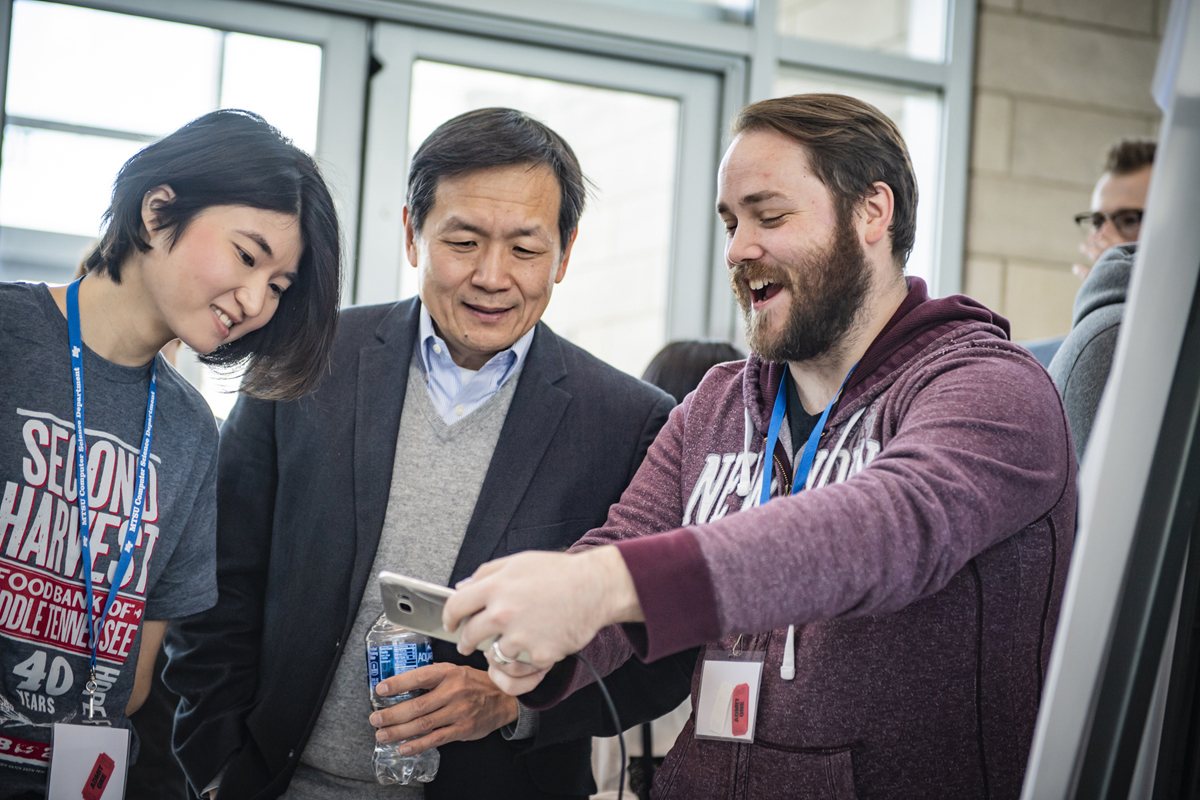
MTSU senior Thomas Scott, right, demonstrates his augmented reality group’s application during the fourth annual Hack MT Jan. 27 in the Science Building. (MTSU photo by Kimi Conro)

Knowing Nashville’s and the Midstate’s growing technology needs, the fourth annual event brings together college and university teams — plus a high school student or two — to collaborate among themselves and with mentors, alumni and others to create music, video games, sound tracks, dance games and more.

“These are really brilliant kids,” MTSU President Sidney A. McPhee said of the Second Harvest team and the others.

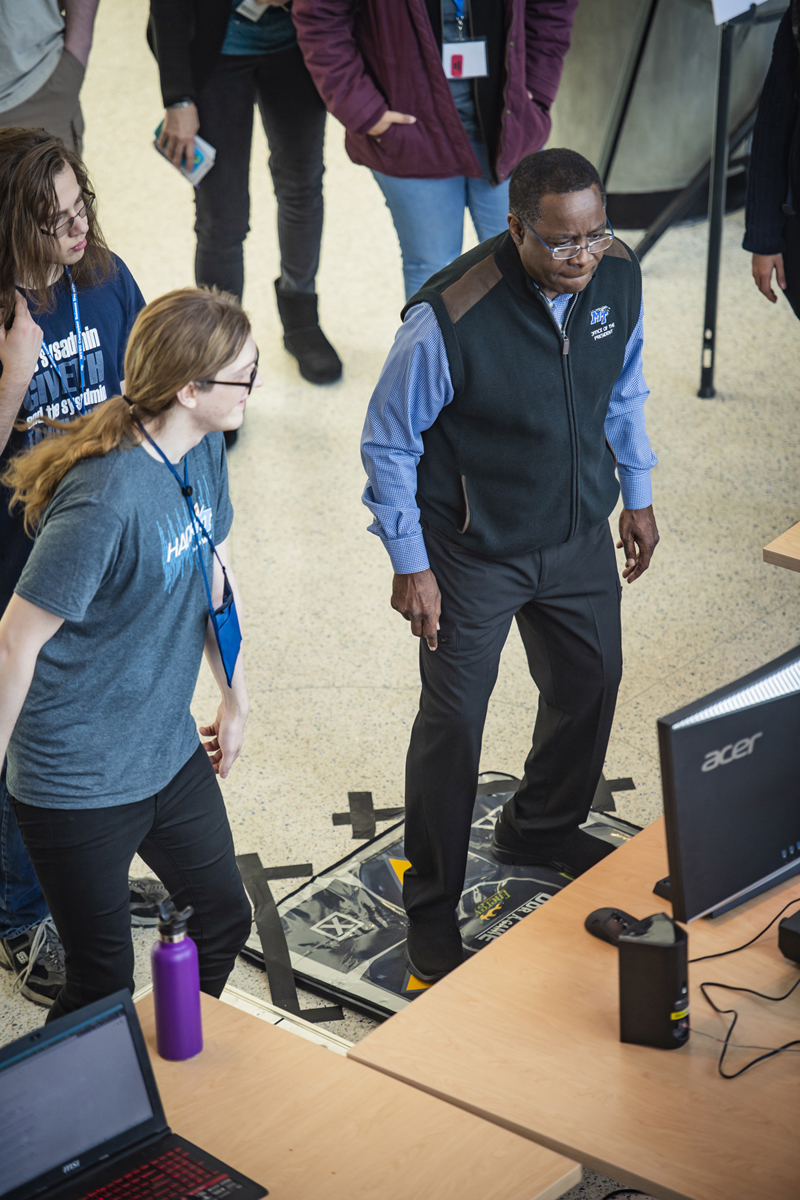
Later, while addressing the students and volunteers McPhee acknowledged their “innovation, creativity and endurance.” He visited virtually all of the teams and even accepted alumnus Steven Sheffey’s dance challenge for the “Breakdown” game.

The drive of Charlie Apigian, interim director of MTSU’s Data Science Institute, initiated the collaboration with Second Harvest and instilled passion and determination for the 25 team members that included computer science, information systems and mathematics students from five universities.

“Teamwork was huge,” said Rosh Chalkery, 19, an MTSU junior information analytics major from Nashville, discussing the Second Harvest team and adding that “we’re going to continue to help Second Harvest continue to serve the homeless in Middle Tennessee.”

“What I love about Hack MT is that it’s the perfect opportunity for students getting started in technology, coming in and seeing what they are capable of,” said Apigian, whose team earned the Hackers Choice Award.

2019 Hack MT crowd

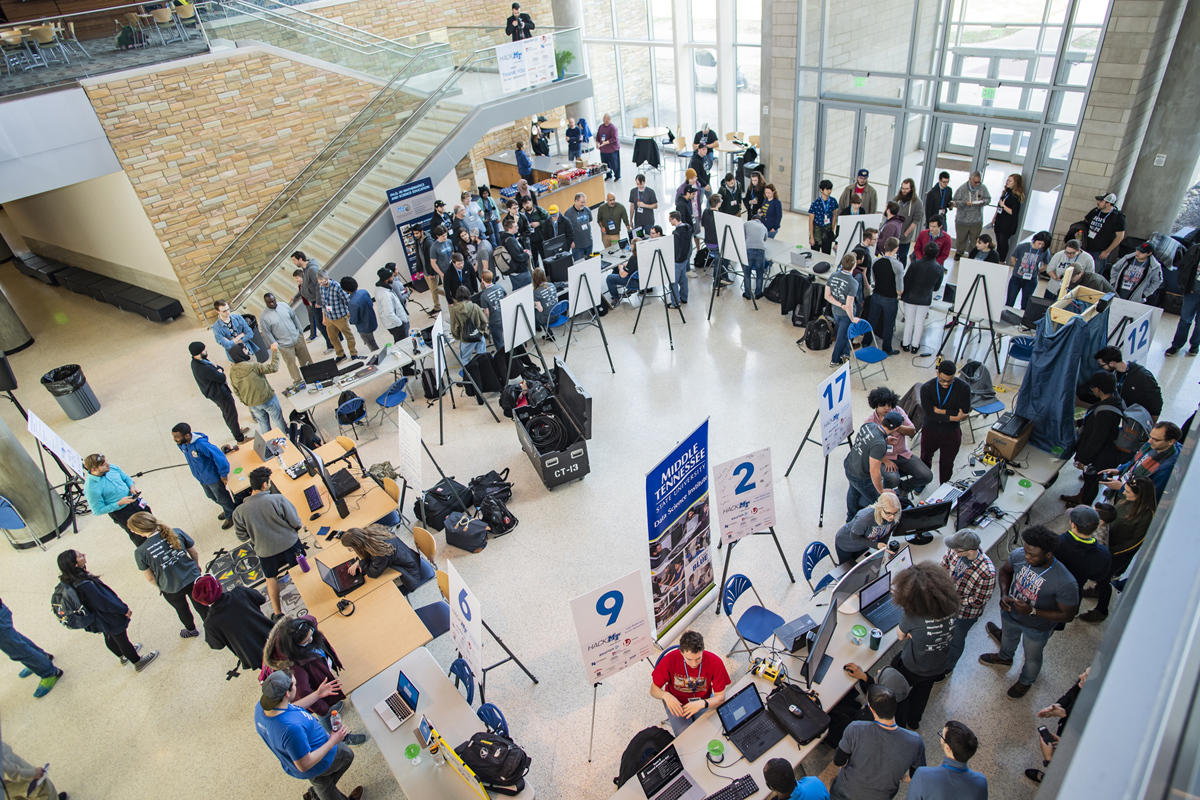
Judges and visitors review the teams’ projects during the “science fair” portion of the fourth annual Hack MT Jan. 27 in the MTSU Science Building. The three-day, 36-hour hackathon drew a record 200-plus students. (MTSU photo by Kimi Conro)

Frank Ellmo, Second Harvest senior director of operations, called the students’ efforts “amazing. … We were here Friday night for the pitch, we came back for two hours Saturday to answer questions and this (project) is a really cool display. I can take that to drive how I model the physical plant. I can’t wait until next year. This was a lot of fun.”

Allie Binkley, 30, a wife, mother and MTSU information systems graduate student, said being on the 10-member Travelcast.me app team was “fun, awesome and I’m super proud of our team,” she said. Callie Deas, 22, a Belmont University senior and computer science major from Columbus, Ohio, called it “a great learning experience and the more we worked together the more we got to know each other.”

Hack MT logo

Jacob Rakidzich, a mobile application developer with Brentwood, Tennessee-based Ramsey Solutions, said it was “awesome to see young people willing to collaborate and work together and learn to deliver a product.”

One team he monitored, in devising a self-driving car program, had their computer hardware malfunction. “They didn’t just quit. They changed and adapted with hours to spare. They ended up not competing (for awards), but they made an impression.”

MTSU alumna Cassie Martin (Class of 2012 in business management in the Jones College of Business) said her company, L3 ForceX, joined Asurion as a co-primary sponsor in its first Hack MT venture and they were there “recruiting for internships and full-time positions. We’re here looking at this talent.”

Martin and her L3 colleagues had “better opportunities to get to know them” and learn, through teamwork, that “all departments in all areas of the business work together. That’s how a business runs.”

CDUB won first place at Hack MT

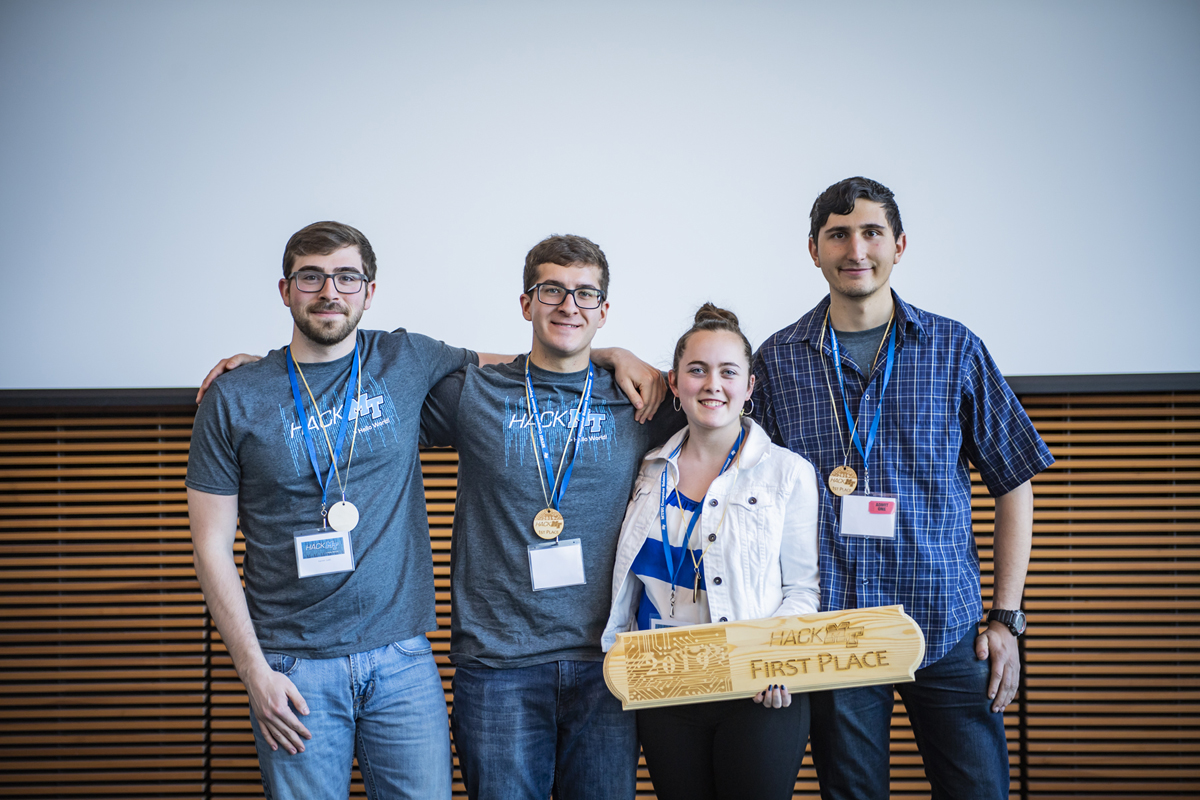
Team CDUB members Candace Boyce and Jacob Crawford of MTSU and Garrett Ladd and Matt Klomfas of the University of Tennessee-Knoxville are shown with their Professional Choice Award they earned Jan. 27 during the fourth annual Hack MT in the Science Building. (MTSU photo by Kimi Conro)

Senior homeschooler Nathan Malone, 18, of Murfreesboro, joined Luke’s team — Luke StanleyAndrew DillingerMuhammed AbedJordan FlowersJonathan Shields — that created a last-minute TowerFall-type retro screen game when their original idea fell through regarding a proposed solution for Nashville traffic during bad weather.

Team CDUB — MTSU students Candace Boyce and Jacob Crawford joined by University of Tennessee-Knoxville students Garrett Ladd and Matt Klimfas— earned first place in the Professional Choice Awards. They created an “augmented reality sandbox” that would change colors, based on terrain, when things were moved.

Computer science is one of 11 departments in the College of Basic and Applied Sciences.

—(Randy Weiler@mtsu.edu)

MTSU President Sidney A. McPhee participants in Hack MT "Breakdown Game" challenge.

MTSU alumnus Steven Sheffey, left, MTSU challenges MTSU President Sidney A. McPhee to a dance-off in his group’s “Breakdown” game Jan. 27 during the grand finale to the fourth annual Hack MT in the Science Building. (MTSU photo by Kimi Conro)


Nicholas Matala describes his group’s Second Harvest Food Bank/Data Science Institute product, created in collaboration with MTSU’s Data Science Institute, Jan. 27 during the fourth annual Hack MT in the Science Building. The students are assisting Second Harvest with improving warehouse production. (MTSU photo by Kimi Conro)