Quantum Machine Learning and Variational Quantum Algorithms for Differential Equations

MTSU Computational and Data Science Ph.D. student, Yuan Chen, presents elements from his dissertation proposal on Quantum Algorithms for Differential Equations.
This talk presents a collection of works on quantum and hybrid quantum–classical methods for differential equations, with emphasis on the two directions: learning-based quantum models for dynamical systems and lightweight quantum recurrent architectures. Differential equations are central to modeling complex phenomena across science and engineering, yet many important problems remain challenging because of oscillatory behavior, chaos, and multiscale structure. The first part studies quantum recurrent neural networks for predicting the dynamics of ordinary differential equations and extends them through an encoder–decoder framework to time-dependent partial differential equations. The second part focuses on architectural efficiency by introducing minimal quantum recurrent models that retain only the most essential quantum components while shifting the remaining operations to classical layers. These works demonstrate how quantum recurrent models can be used to learn differential-equation dynamics while discussing the trade-offs among predictive accuracy, parameter efficiency, runtime, and trainability.


Watch the seminar here.

2026-27 Data Science Student Steve and Kathy Anderson Scholarship Winners

We are excited to announce the recipients of the prestigious Steve and Kathy Anderson Scholarship for the 2026–2027 academic year! This highly competitive scholarship recognizes outstanding students in the MTSU Data Science program who have demonstrated exceptional academic achievement, passion for data science, and a commitment to making a meaningful impact here at MTSU. This year, four recipients will receive a $3,000 award to support their continued studies and growth in the upcoming academic year.

This year’s scholarship winners include both undergraduate and graduate students, reflecting the broad talent and dedication across all levels of our MTSU data science programs. Congratulations to Tomy Chet, Emma Yarbrough, Pratyusha Shanker, and Heli Patel! These students stood out among their peers for their strong academic performance, involvement in the MTSU data science community, and potential for future contributions to the industry. We are proud of their accomplishments and can’t wait to see the exciting work they’ll pursue in the coming year.

MTSU Data Science is committed to supporting student success and cultivating future leaders in data science. We are extremely grateful for the generosity of Steve and Kathy Anderson. Because of the Steve and Kathy Anderson Scholarship, our students are able to focus more fully on their education, research, and professional development. Please join us in congratulating Tomy, Emma, Pratyusha, and Heli on this well-deserved recognition!

TriAffect: Tri-Modal Conversational Emotion Recognition with Temporal State Tracking

Computational and Data Science Ph.D. student, Cayden Schalk, presents his research work on Emotion Recognition. 

Understanding emotion in conversation requires combining cues from language, vocal expression, and visual behavior while accounting for how emotion evolves across speakers and dialogue turns. This problem is important for multimodal interactive systems such as emotion-aware assistants, social robots, and assistive technologies. We present TriAffect, a tri-modal extension of MemoCMT for conversational emotion recognition that jointly models what is said, how it sounds, and how speakers appear, while tracking each speaker’s emotional state across the conversation. The model combines symmetric pairwise text-audio-video fusion with speaker-aware temporal state tracking across dialogue turns. We evaluate TriAffect on the 4-class IEMOCAP benchmark with leave-one-session-out (LOSO) cross-validation and further analyze its components on MELD. On IEMOCAP, the full temporal model achieves 77.5%±2.8 balanced accuracy, outperforming the MemoCMT baseline by 5.3 points and improving over its own non-temporal version by 6.3 points. These results highlight the promise of combining tri-modal fusion with speaker-aware temporal modeling for conversational emotion recognition.

Watch the presentation here.

Addressing Computational Challenges in Geospatial Applications using Graph Structures

Computational and Data Science Ph.D. student Abigail Kelly presents elements from her internship and research. Her research focuses on Geospatial Data and Graph Theory – specifically, how to extract patterns from this difficult type of data. 

Geospatial data science focuses on extracting patterns and knowledge from data containing a spatial or geographic component. This discipline is integral to diverse fields, including public safety, infrastructure development, environmental science, and public health. For instance, spatial data can identify crime hotspots for public safety, guide business placement for infrastructure development, map species relationships in environmental science, and track disease vectors in public health. Despite its utility, the field faces significant challenges, including spatial autocorrelation, the scale of big data, large memory demands, and high computational complexity. This dissertation proposes novel graph-based techniques to address key computational challenges in geospatial data science. The research first introduces a novel technique for estimating neighborhood distance thresholds in colocation mining. To reduce the memory footprint of spatial analysis, it then presents a memory-efficient regional colocation mining algorithm. Furthermore, the work develops a scalable colocation mining algorithm featuring a tighter upper-bound filter and faster refinement processes. Finally, a livability index is implemented using Graph Neural Networks to address the effects of spatial autocorrelation. 

Watch the presentation here.

Faculty and Staff Spotlight – Lisa Eddy

Lisa Eddy is one of the advisors for the Data Science Program. Lisa advises students whose last names begin with A-K.

What is your degree?  B.S. in Liberal Studies with an emphasis in Administration and Education  

Advice for Students  

Don’t limit yourself by going it alone! Think of campus like a Data Science project. Gather information from different resources … clubs, advisors, tutoring, faculty, counseling, health services, and more. Then process it based on what you need at the time. And make your decisions being more fully-informed.  The better your inputs, the better your output.  

Outside of Work  

I enjoy traveling, geocaching, escape rooms, and board games.  

Fun Fact  

I lived in Scotland for just over a year while taking a break from college (similar to a gap year). I worked at a 150-bed independent youth hostel, meeting and helping people from all over the world.  This is the foundation of my advocacy for travel and study abroad. 

Predictive Maintenance for heavy equipment with a classical and Quantum Support Vector Machine using novel data

Computational and Data Science Ph.D. student, Laurel Koenig, presents elements from their internship and research, Predictive Maintenance for heavy equipment with a classical and Quantum Support Vector Machine using novel data.  This work shows the differences between quantum and classical machine learning on a real-world dataset 

Predictive maintenance is the blanket term for methods used to maximize the lifetime of equipment by predicting when it will fail. Most predictive maintenance uses specialized sensors, but in this study we used a novel data set created from generalized equipment data that was already being collected from Caterpillar machines. We applied both classical and quantum support vector machines to predict machine failure. The classical machine used an RBF kernel with limited success. The quantum SVM utilized a trainable kernel that was formulated to be a RBF kernel as a baseline. The difference between the results of the classical and quantum algorithms is not statistically significant.

Watch here.

Predictive and Representation Learning for fMRI-Based Brain Disorder Analysis

Computational and Data Science Ph.D. student, Haoyuan Wang, presents Predictive and Representational Learning for fMRI-Based Brain Disorder Analysis. 

Neural network–based predictive and representation learning approaches are developed to improve model reliability and representational capacity for complex fMRI data. The capability of neural networks to capture high-dimensional, nonlinear structures is first examined, and a custom loss function is introduced to enhance prediction reliability through improved uncertainty quantification and robustness. Building on this foundation, a deep learning framework for autism spectrum disorder (ASD) classification is proposed, leveraging fused feature representations derived from functional connectivity to more effectively characterize brain network patterns. The framework is further extended to the more challenging task of attention-deficit/hyperactivity disorder (ADHD) classification, which involves greater heterogeneity and complexity in neural signals. To address these challenges, a hybrid modeling approach integrating quantum computing with graph neural networks is introduced, providing enhanced expressive power for modeling complex brain connectivity.

Watch the webinar here,

Parallel Algorithms for Open-Locating Dominating Sets

Computational and Data Science Ph.D. student, Robert Dohner, presents an overview of algorithms for computing open-locating-dominating (OLD) sets, a graph-based framework for fault detection and sensor placement in networks.

This seminar introduces Infrastructure as Code (IaC) and discusses its relevance to data science research. Using Terraform as an example, the talk demonstrates how computing environments and machine learning workflows can be defined and deployed programmatically in the cloud.

For a graph G, distinguishing sets can be used for detection purposes. Whether it be setting up sensors to detect a thief in a facility or detecting a faulty component in a network of processors, these types of sets can be used to minimize the number of sensors required for the grid or network. Recently, there has been a lot of research into dealing with distinguishing sets, including on open-locating-dominating (OLD) sets, which is the graphical parameter this research focuses on.  For our research, programs were developed to find OLD sets and the value of OLD(G) for various classes of graphs. In particular, in order to find the minimum density of an OLD set for the infinite king’s graph, an algorithm was created that parallelized the program using a backtracking algorithm, and the program has confirmed the previous results. Additionally, we present a proof for the NP-completeness of a fault-tolerant OLD set called a redundant OLD set.

Watch the webinar here.

Faculty and Staff Spotlight – Dr. Ramchandra Rimal

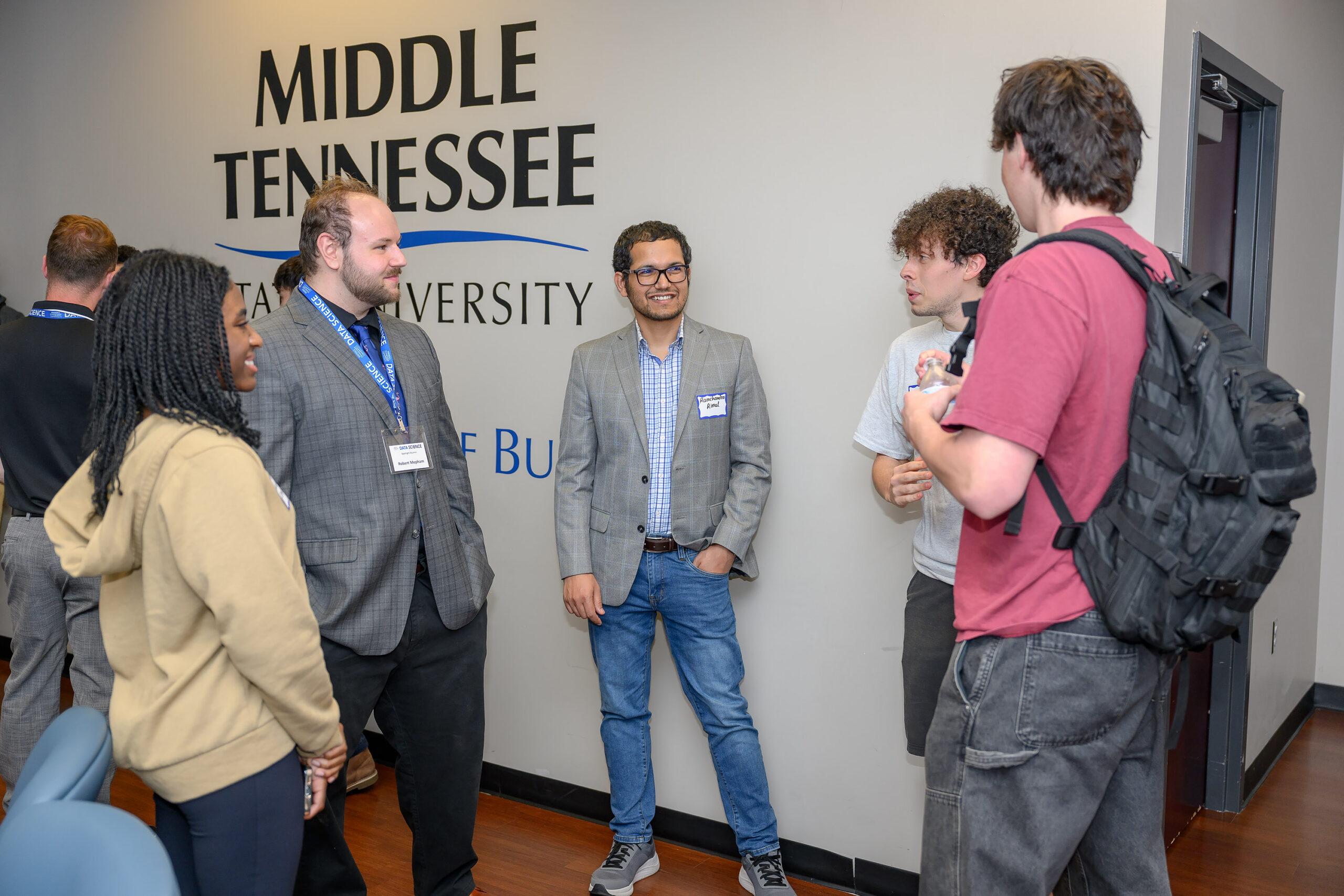
Dr. Rimal is the advisor for the Graduate Certificate in Data Science and an Assistant Professor in Mathematical Sciences.

Year joined MTSU: 2020 
 
Data Science Classes Taught 

DATA 3550 Applied Predictive Modeling 

DATA 6990 Topics Seminar in Data Science 

Data Science Involvement at MTSU 

Developing data science courses, mentoring students, and participating/organizing events on machine learning and data science. 

Why Data Science? 

I chose data science because my background in mathematics and statistics enables me to understand, adapt, and create new tools that can directly influence real-world phenomena and solve complex problems. 

Advice for Students 

Master the fundamentals, not the tools; the core knowledge provides longevity in a constantly evolving field. 

Research & Academic Interests 

My research interests are Machine Learning, Statistical Network Models, and Data Science 

Outside of Work 

My hobbies include staying informed about economics and AI, playing badminton, and spending time with my kids. They all provide a different way to think strategically and stay sharp. 

Fun Fact 

A fun fact about me is that I have a passion for long-distance hiking. My personal record is 33 miles in a single day, which I achieved while in college, and it taught me a great deal about strategy and endurance

Infrastructure as Code for Data Science: Reproducible Machine Learning Workflows with Terraform

Computational and Data Science Ph.D student, Dongyu Liu, presents an overview of the open source Terraform framework. This system is a fascinating approach toward machine learning workflows, deployment, and provisioning of ML systems on both local and cloud resources.  

This seminar introduces Infrastructure as Code (IaC) and discusses its relevance to data science research. Using Terraform as an example, the talk demonstrates how computing environments and machine learning workflows can be defined and deployed programmatically in the cloud.

The presentation focuses on how IaC can improve reproducibility, support collaborative research, and simplify experiment management. A short demo will illustrate how data science environments and computational workflows can be set up and reproduced using a Terraform-based setup.

Watch the seminar here.